Amazon SEO vs PPC: What Should You Fix First?

Summary

Comparison framework for deciding whether listing or advertising work should be reviewed first. The choice uses seller-authorized account evidence, product economics, and the observed bottleneck; no undisclosed ranking rule or compounding outcome is claimed.

A practical framework for deciding whether your next growth move should be Amazon SEO or PPC, based on traffic quality, conversion readiness, and account stage.

Written by Maksym Lazuto. This guide is part of the BFarm Academy and connects to services, proof pages, and the free audit flow.

Explore Services See Case Studies Read Academy Book a 30-min call Get the free audit

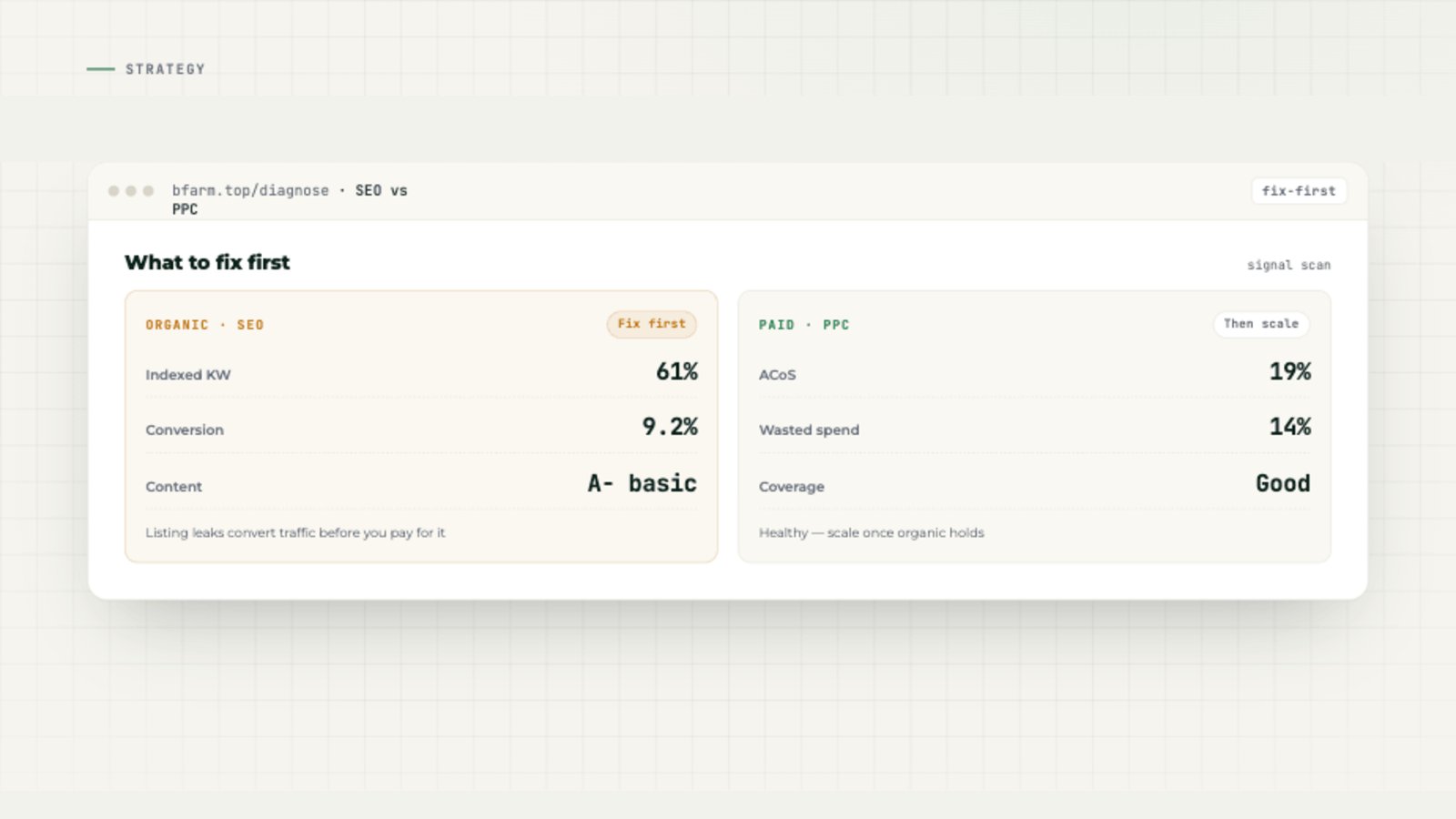
Short answer: fix SEO first when the listing is not relevant, not indexable enough, or not aligned with buyer intent. Fix PPC first when the listing can already convert qualified traffic but acquisition is inefficient, misstructured, or missing coverage on high-intent terms.

Decision table

Signal SEO first PPC first
Keyword relevance Important terms missing from title, bullets, backend, or A+ flow Relevance is already solid
Traffic quality Wrong search intent is landing on the listing High-intent traffic exists but costs too much
Conversion readiness Listing proof is weak, objection handling unclear Listing is good enough to convert more if traffic is managed better
Account stage Foundation or repositioning phase Scaling or efficiency recovery phase

When SEO should come first

If the listing is misaligned with what shoppers are actually searching for, PPC will often magnify the wrong message faster than it creates durable growth. Missing keyword coverage, weak title structure, unclear bullets, and low-trust image sequencing are all reasons to fix SEO and conversion fundamentals before adding more paid pressure.

This is especially true when campaign search term reports show a relevance problem rather than just a bid problem. When traffic is mismatched to the listing promise, CPC optimization alone will not solve the underlying friction.

When PPC should come first

PPC deserves priority when the listing already communicates fit and proof, but campaigns are poorly segmented, negatives are weak, or budgets are not aligned to intent tiers. In that situation, acquisition cleanup may belong before a full content rewrite.

Common symptoms include bloated spend in exploration campaigns, missing exact-match protection on high-value terms, or strong conversion on some searches but poor exposure on the terms that matter most commercially.

What usually works in real accounts

In practice, this is rarely a pure either-or decision. The better model is sequencing: fix the minimum viable listing relevance and proof first, then tighten PPC structure so paid traffic reinforces rather than compensates for weak fundamentals. This is how you avoid scaling spend into a conversion bottleneck.

Use a documented measurement window appropriate to the report, attribution model, traffic volume, and change. That protects teams from reacting too early to noisy PPC or indexing shifts.

What to do next

If you are unsure which side is the primary constraint, start with a structured free audit. Then go deep on whichever side you are fixing: the full Amazon PPC & advertising pillar or the Amazon SEO & listings pillar. For specifics, compare this framework with our Amazon PPC guide, the listing conversion guide, and relevant proof from the portfolio.